Nobel Prize Honors Optogenetics Breakthrough Born From Algae


A tiny green alga that swims toward light seems like an unlikely starting point for one of neuroscience’s biggest breakthroughs. Yet research into how these single-celled organisms respond to light eventually gave scientists something they had wanted for decades: a way to switch specific brain cells on and off and see what happens.
That work is now at the center of the 2026 Nobel Prize in Physiology or Medicine. On October 5, the Nobel Assembly awarded the prize to Karl Deisseroth, Peter Hegemann, and Georg Nagel “for their discoveries concerning light-gated ion channels and optogenetics.” The technique has changed how researchers investigate the brain by allowing them to test which neurons contribute to behaviors, emotions, and other biological processes rather than simply observing which areas of the brain become active.
The breakthrough started with algae
The story begins with Chlamydomonas reinhardtii, a single-celled green alga capable of swimming toward light. Hegemann spent years investigating how the organism senses light, and his work eventually converged with Nagel’s research. In the early 2000s, Hegemann, Nagel, and their colleagues identified and characterized light-sensitive proteins that became known as channelrhodopsins.
Channelrhodopsins essentially act like tiny gates. When exposed to certain wavelengths of light, they open and allow electrically charged particles to flow across a cell membrane. As Nature explains in its account of the Nobel-winning research, Hegemann and Nagel showed that the channelrhodopsin they studied responded to blue light by creating a small electrical charge and that other cells could be made light-sensitive by introducing the protein.
That raised an intriguing possibility. Neurons communicate using electrical signals, so what would happen if scientists put the gene for a light-sensitive channel into a neuron?
In a landmark 2005 experiment, Deisseroth and his colleagues showed that channelrhodopsin-2 could be introduced into mammalian neurons and used to control their firing with millisecond precision. Short pulses of light could tell selected neurons when to become active. The study also involved Edward Boyden, Feng Zha ng, Ernst Bamberg, and Nagel, reflecting the wider group of scientists whose work helped build what became known as optogenetics.

A light switch changed how scientists study the brain
The real power of optogenetics is not simply that light can make neurons fire. It is the control researchers gain over which neurons respond and when.
The brain contains billions of neurons arranged in complicated circuits, making it difficult to determine whether activity in a particular group of cells actually causes a behavior. Optogenetics gave researchers a way to manipulate selected cells while leaving neighboring ones alone, then observe what changed. Nature describes this ability to test cause and effect as one of the reasons optogenetics changed neuroscience so profoundly.
Researchers have since used the technique to investigate neural circuits involved in memory, movement, reward, hunger, fear, and other behaviors. A scientist can activate a particular group of neurons and see whether a behavior appears, or suppress those cells and see whether it disappears. Over the past two decades, variations of the technique have spread through neuroscience and into other areas of biology.
Deisseroth offered a simple way of explaining the difference while speaking with WBUR after winning the Nobel. Light is normally something scientists use to see or image an object. With optogenetics, they instead use light to make something happen inside a cell.
Optogenetics is beginning to reach human medicine
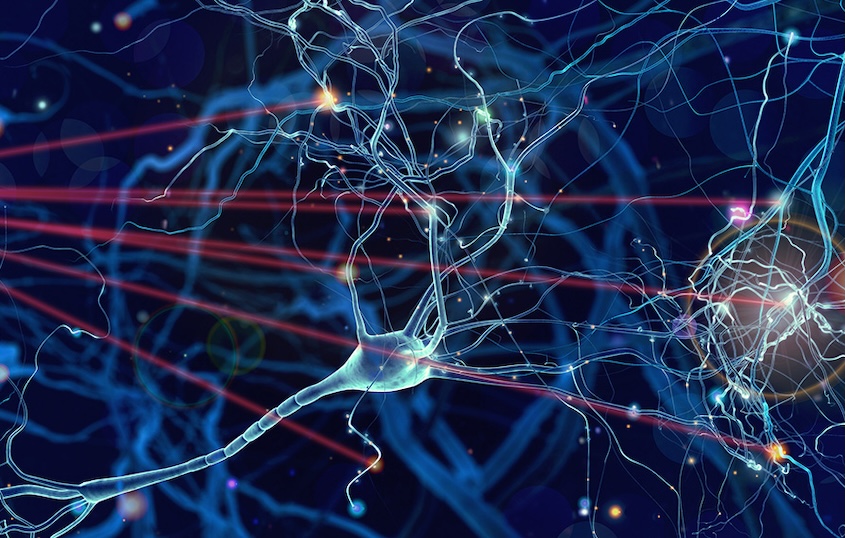
For all its influence in neuroscience laboratories, optogenetics has not become a routine treatment for brain disorders. Applying it directly in humans is much harder because cells generally need to be genetically altered to respond to light, and researchers also need a practical way to deliver that light to the right cells.
One area has already provided an early glimpse of what medical optogenetics could look like. Researchers have tested the approach in people with retinitis pigmentosa, a group of inherited diseases that gradually destroy the retina’s light-sensing photoreceptor cells. Rather than replacing those lost cells, researchers are investigating whether surviving retinal cells can be made sensitive to light instead.
In 2021, researchers reported that an optogenetic therapy partially restored visual function in a man who had lost his sight from retinitis pigmentosa. After treatment, he was able to locate, count, and touch objects while using special goggles that projected light onto the treated eye. Research has continued since then, and recent clinical data reported by Ophthalmology Times show that experimental optogenetic therapies are still being studied in people with advanced retinitis pigmentosa.
That does not mean optogenetic treatments are ready for widespread use. The retinal approaches remain experimental, and much of the technology’s medical value may ultimately come from what it teaches scientists about disease rather than directly treating patients with light. In his interview with WBUR, Deisseroth explained that identifying the cells responsible for particular symptoms could help researchers find other ways to target them, including through drugs.
A Nobel more than two decades in the making
The prize arrives more than 20 years after the experiments that established optogenetics as a neuroscience tool, and recognition had been expected for years. As Nature reported following the announcement, optogenetics received one of its first major honors with the Brain Prize in 2013. That award recognized Deisseroth, Hegemann, Nagel, Boyden, Gero Miesenböck, and Bamberg, showing how many researchers contributed to the field beyond the three scientists a Nobel Prize can recognize.
The long wait also gave scientists time to show how useful the technique could become. What started with researchers trying to understand how a microscopic alga responds to light ultimately produced a tool that lets scientists manipulate particular types of cells inside functioning neural circuits.
Optogenetics still has a long way to go before its medical potential becomes clear. But its path from light-sensitive algae to experiments in the living brain helps explain why the work earned science’s most famous prize. A biological mechanism that helps a tiny organism respond to light ended up giving scientists an entirely new way to investigate how the brain works.
For more articles like this, visit our Lifestyle News Page!