NASA Names Artemis III Crew for 2027 Mission


NASA has taken another step toward returning humans to the Moon, announcing the four astronauts who will fly on Artemis III, a mission scheduled for 2027 that will test critical spacecraft and landing systems needed for future lunar expeditions.
The mission is scheduled for 2027 and will send NASA astronauts Randy Bresnik, Frank Rubio, and Andre Douglas into space alongside European Space Agency astronaut Luca Parmitano. Bresnik will serve as commander, Parmitano will serve as pilot, and Rubio and Douglas will serve as mission specialists. NASA astronaut Bob Hines was also named as a backup crew member. According to NASA, the crew was selected to help carry out one of the agency's most ambitious and technically demanding missions in decades.
The announcement marks an important milestone for the Artemis program, though Artemis III will not land on the Moon as originally planned. Instead, the mission will focus on a series of demonstrations in low Earth orbit designed to prove that the spacecraft, docking procedures, and lunar landing systems needed for future Moon missions can operate safely with astronauts on board.
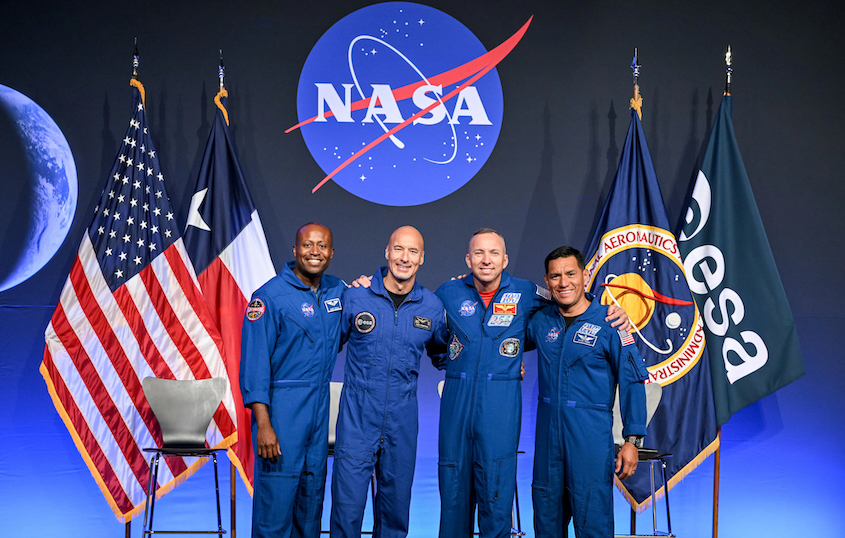
NASA says the crew will launch aboard the Orion spacecraft on top of the Space Launch System rocket from Kennedy Space Center in Florida. Once in orbit, Orion will test rendezvous and docking capabilities with lunar landing systems being developed by Blue Origin and SpaceX. The mission is intended to demonstrate that these systems can safely work together before astronauts rely on them during future journeys beyond Earth orbit.
The flight is expected to last about two weeks and will involve a complex series of operations between multiple spacecraft. NASA officials described Artemis III as a critical test mission that will validate hardware, software, life-support systems, and operational procedures before the agency attempts a crewed lunar landing later in the Artemis program. NASA Artemis Program Manager Jeremy Parsons called the mission a highly coordinated effort involving several launches and some of the world's most powerful rockets.
The four astronauts bring a wide range of experience to the mission. Bresnik is a veteran astronaut who has flown on both the space shuttle and Soyuz spacecraft. Rubio holds the record for the longest single spaceflight by an American astronaut after spending 371 consecutive days aboard the International Space Station. Parmitano is a former commander of the International Space Station and will become the first European Space Agency astronaut assigned to an Artemis mission. Douglas, a systems engineer and former U.S. Coast Guard officer, will be making his first trip to space after supporting NASA's Artemis program in several ground-based roles.

The mission also highlights the growing role of international and commercial partnerships in space exploration. While NASA will provide Orion and the Space Launch System rocket, Blue Origin and SpaceX are developing the lunar landing systems that future Artemis crews are expected to use. Parmitano's selection further expands European involvement in a program that NASA hopes will establish a sustained human presence on and around the Moon.
Artemis III follows the successful Artemis II mission, which carried astronauts around the Moon earlier this year. While the upcoming flight will remain in Earth orbit, NASA views it as a necessary step toward future lunar surface missions and its broader goal of preparing for human exploration of Mars.
For NASA, the Artemis program is about more than repeating the achievements of the Apollo era. Agency officials have repeatedly described it as the foundation for long-term exploration beyond Earth, with Artemis III serving as one of the most important tests yet of the systems that could eventually carry astronauts back to the Moon and onward to deeper destinations in space.
For more articles like this, visit our lifestyle news page!