Walmart Removes Self-Checkout as Theft Hits Highs

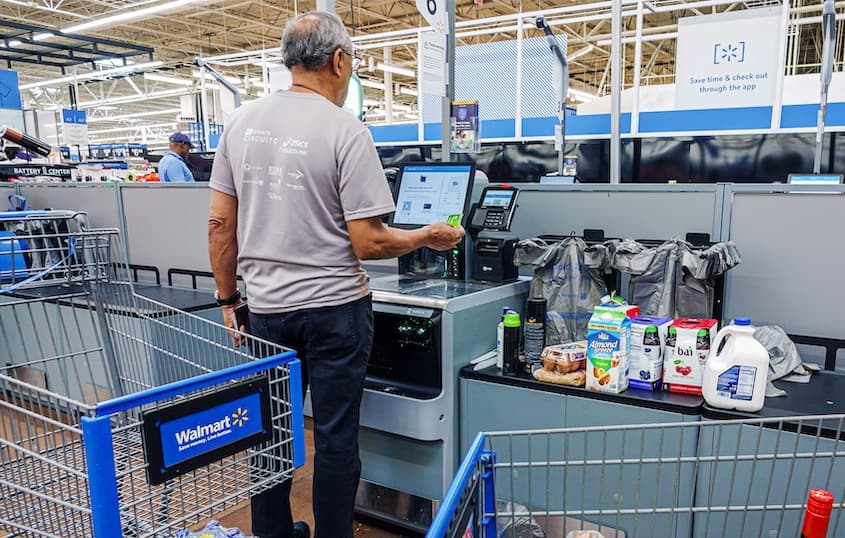
For years, self-checkout felt like the future of shopping. Retailers framed it as faster, cheaper, and more convenient. Customers could scan a few items, skip awkward small talk, and get out of the store in minutes. Now, some of the country’s biggest chains are quietly backing away from the technology that once symbolized modern retail.
Walmart is the latest major retailer scaling back self-checkout lanes at select stores across the U.S., including a recent rollback at a South Philadelphia Supercenter. The company says the move is tied to customer feedback and a desire to improve service. But behind the corporate language sits a more complicated reality involving theft, rising food prices, labor shortages, and the growing limits of automation in everyday life.
The South Philadelphia store is only the latest example. Walmart has already removed or reduced self-checkout access in locations across Missouri, Ohio, and New Mexico. At the same time, the retailer announced plans to remodel more than 650 stores and open roughly 20 new locations by early 2027, with checkout redesigns becoming part of the broader overhaul.
The official explanation sounds customer-friendly. Walmart says each decision depends on local shopping habits, community needs, and employee feedback. And to be fair, plenty of shoppers never fully embraced self-checkout. Frozen screens, barcode errors, and the infamous “unexpected item in bagging area” warning became part of the modern grocery experience.
Still, the numbers behind the shift tell a far more revealing story.
According to a December 2025 LendingTree survey, 27% of self-checkout users admitted they intentionally stole at least one item while using the kiosks. That figure jumped sharply from 15% in 2023. Another 36% said they accidentally left with unscanned merchandise, and most admitted they kept the items instead of returning them.
Perhaps the most telling statistic was this: nearly 70% of shoppers said self-checkout makes stealing easier.
That matters because retail theft, often referred to as “shrink,” has become one of the industry’s biggest financial headaches. What looked like a labor-saving innovation increasingly turned into a system built almost entirely on trust. In practice, many retailers discovered that fewer cashiers sometimes meant more losses.
And in some Walmart locations, the difference after removing self-checkout has been dramatic.
In Shrewsbury, Missouri, police calls to a Walmart store reportedly dropped from 509 to 183 after self-checkout was removed. Arrests at the location were cut by more than half over the same period. Local law enforcement directly linked the decline to the return of traditional cashier-operated lanes.
The timing of all this is hard to ignore. Grocery prices remain elevated across the country, with food costs rising 2.7% year over year in March 2026, according to federal estimates. The USDA projects prices will continue climbing through the year.
Retail analysts increasingly believe self-checkout became a perfect storm of economic pressure and opportunity. Some shoppers deliberately exploit the system. Others simply stop paying attention while juggling kids, phones, or large grocery runs. Either way, retailers absorb the loss.
What makes this moment especially interesting is that stores are not exactly abandoning technology. They are simply becoming more selective about where automation actually works.
Sam's Club, owned by Walmart, is replacing traditional self-checkout with AI-powered Scan & Go systems. Costco has added more employee oversight to self-checkout areas, including staff who verify carts before customers leave. Target introduced item limits at many self-checkout lanes after seeing checkout speeds improve. Meanwhile, Dollar General removed self-checkout from roughly 12,000 stores.
In other words, the retail industry is admitting that fully unattended automation may have been oversold.
During the 2010s, tech-driven convenience became the dominant philosophy in retail. Customers were expected to do more themselves, whether scanning groceries, ordering through apps, or navigating digital kiosks. The promise was efficiency.
But increasingly, consumers seem split on whether that trade-off was worth it. Some shoppers love the speed of self-checkout. Others feel like they were turned into unpaid store employees while companies reduced staffing.
Now lawmakers are getting involved too. States including California, New York, Massachusetts, and Washington are considering laws that would regulate self-checkout systems by requiring more employee supervision or limiting how many items customers can process themselves.
Ironically, the future of retail may end up looking a little more old-fashioned than expected. Not because technology failed completely, but because stores are discovering that convenience, trust, and human behavior are far harder to automate than scanning a barcode.
For more articles like this, visit our Lifestyle News Page!