A Screen-Free Childhood Is Becoming a Luxury


Somewhere along the way, childhood became something that had to be scheduled, paid for, and planned. The freedom to spend an afternoon riding bikes, wandering the neighborhood, or simply exploring outside has given way to organized activities, packed calendars, and, when none of those are possible, a glowing screen. In 1969, nearly half of American schoolchildren walked or biked to school on their own. By 2009, that number had fallen to roughly one in eight.
It is easy to look at a child's phone and assume it is the culprit, but that explanation misses a larger shift. What screens really did was move into a space that had been quietly shrinking for decades, closed off not by Silicon Valley but by rising costs, disappearing safe places to play, and parents with less and less time to spare.
Youth sports now come with registration fees, travel, and equipment. The average American family spent $1,016 on a child's primary sport in 2024, a 46 percent jump since 2019. Even a simple outing to the park increasingly requires something many families are just as short on as money: time, and somewhere safe to go. As work schedules stay busy and everyday costs climb, the activity already sitting at home, free and always available, tends to be the one that wins.
That shift has quietly redefined what privilege looks like. A generation ago, having a computer or home internet was the mark of opportunity. Today, it may be that having enough time, flexibility, and money means a screen doesn't have to be the default.
Content
A Widening Gap

For years, conversations about childhood and technology centered on the digital divide: the worry that some kids had computers and broadband while others didn't. That gap has narrowed considerably in the U.S. The more revealing question today isn't who has access to technology, it's what children have access to once they put it down.
That gap is measurable, and it's widening. The disparity in youth sports participation between the richest and poorest American children grew from roughly 14 percentage points in 2012 to more than 20 points by 2024, according to the Aspen Institute's 2025 State of Play report. Neighborhood parks tell a similar story: low-income neighborhoods have, on average, 42 percent less park space per resident than wealthy ones.
Why Screens Win
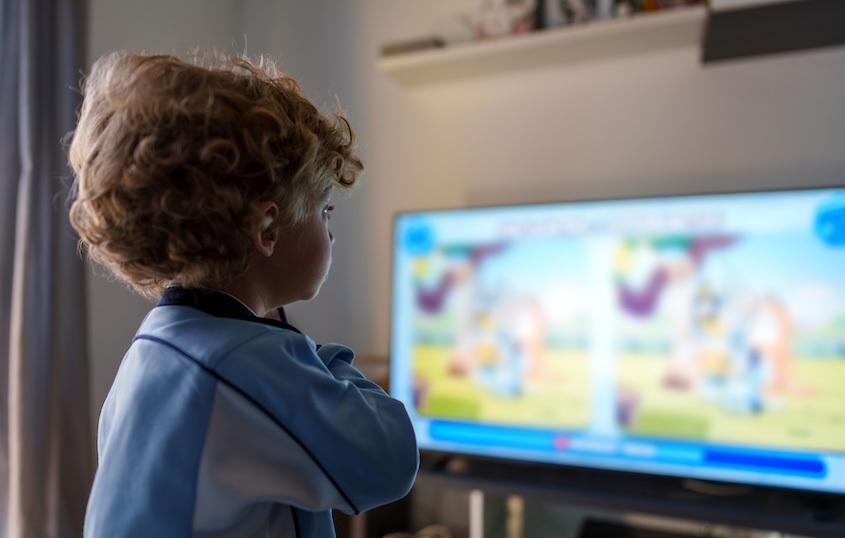
Most parents don't reach for a screen because they think it's the best possible use of their child's time. They reach for it because it fits the realities of modern life, keeping a child occupied while dinner is on the stove, filling the stretch between homework and bedtime, or serving as the fallback when a late shift leaves few other options. The alternatives usually require planning, a car, money, or time, resources that are in short supply at the end of a long day.
Even pediatric guidance has caught up with this reality, as The American Academy of Pediatrics no longer recommends a single numerical screen-time cutoff for school-age children and teens, acknowledging that rigid limits rarely capture what actually matters: content, context, and what the screen is displacing. Moreover, the science on how much screen time really affects a child's wellbeing is more modest than headlines often suggest. In one of the largest analyses ever conducted on the subject, spanning more than 355,000 adolescents, Oxford researchers found that technology use explains, at most, 0.4 percent of the variation in teenage wellbeing.
However, none of this means technology is harmless. Some of childhood's most important lessons, like negotiating a disagreement, taking a small risk, or solving an unexpected problem, can't be downloaded or streamed. But the strongest case against screens isn't that they're addictive. It's that the alternatives have quietly gotten more expensive and harder to reach.
Beyond Screen Time

Asking families to spend less time on devices is relatively simple. Building safer neighborhoods, affordable community programs, and public spaces where kids can gather is much harder, but far more likely to reduce screen reliance over the long run.
Meaningful alternatives don't have to be expensive. Some of childhood's most memorable moments are ordinary ones: reading before bed, cooking as a family, tending a garden, taking an evening walk. The challenge isn't convincing parents to engineer a perfect childhood. It's making sure they have enough time and space to build an ordinary one at all.
The right question was never how much time kids spend on screens, but rather why, for so many of them, there's little else within reach.
For more articles like this, visit our lifestyle news page!